Weightlifting. Yearbook 1984
The USSR Weightlifting Team at the 1983 World and European Championships
English summary of Tyazhelaya Atletika. Ezhegodnik 1984 (Moscow: Fizkultura i Sport, 1984), pp. 10–16: the text is paraphrased, not translated; figures are the original images.
The season and the final preparation
1983 was a tense year for the USSR team: the calendar was fuller than usual, with several international meets, the Spartakiad of the Peoples of the USSR and a later-than-customary World and European Championships. The leading lifters, starting in January, had to stay in top form until the World Cup in Tokyo on 10 December, performing at the highest level at the Friendship Cup and the Open American Championships (March), the Blue Swords in the GDR (April) and the Pannonia Cup in Hungary (June), all of which count towards the World Cup. The key step towards the championships, held in Moscow on 22–31 October, was the eighth summer Spartakiad in July, where places were contested and a reliable team was assembled.
Final preparation ran from 8 August to 31 October in three four-week stages. The general preparatory stage aimed to raise general fitness and functional capacity through volleyball, basketball, athletics, acrobatics and swimming, to polish the elements of the classic lifts and to build specific strength in the main muscle groups. Its key feature was large training volume (up to 2,500 barbell lifts) at fairly low intensity, 70–75 %.
The special preparatory stage (September) aimed at a high level of special and functional fitness, better technique in the lifts as a whole and more attention to moral and volitional qualities. Maximum volumes were combined with a marked rise in intensity, in the number of sessions and in the range of special exercises in the weekly cycle, with weights mostly 80–90 % of maximum. The competitive stage (October) aimed at optimal form for the championships, removal of technical faults, simulation of competition in training and better moral-political, psychological and tactical readiness. It used 95–100 % weights. To make performances dependable, each lifter had to show a world-class result at least six or seven times in this stage, finishing the last run at maximum 10–12 days before the meet while volume and intensity fell gradually. Each stage had a lesson-by-lesson plan fixing sets, lifts and their distribution by exercise group and intensity zone.
Scientific support covered constant monitoring of training load with correction, checks on technique with advice to coaches and athletes, and refinement of model characteristics of competitive activity. Special attention also went to ideological education, above all moral and patriotic, and a sense of responsibility to the motherland, state and team, under a fixed plan of political study, briefings, lectures, seminars, communist Saturday work days and meetings with leading workers.
The competition
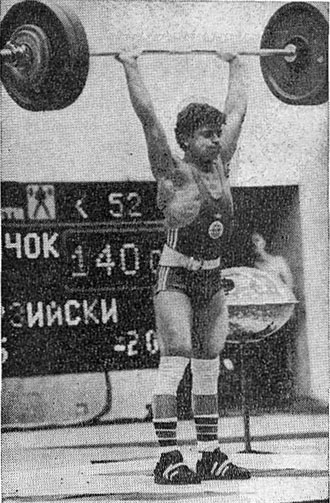
The rivals' recent form, especially the Bulgarians', showed that results in Moscow would have to be very high; at the 37th World Championships 23 world records were set, a first in their history. On the first day, in the 52 kg class, N. Terziyski of Bulgaria set three, including 260 kg in the total, and it became clear that our coaching council's forecast was right: to win, one had to exceed the world record.
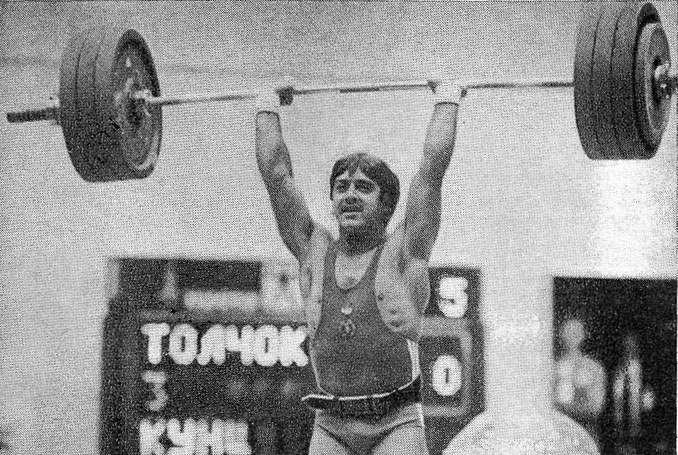
At 56 kg the USSR entered world-record holder Oksen Mirzoyan against A. Letz of the GDR and Bulgaria's “rising star” N. Suleymanov, who turned 16 only after the championships. Suleymanov set a snatch record of 130 kg and, being lighter, left Mirzoyan needing to win back 5 kg in the jerk; Mirzoyan took a risk and opened with 157.5 kg. Suleymanov jerked 160 kg for a total record of 290 kg, and Letz's 161 kg on his third attempt was a jerk record. Mirzoyan, raised to 165 kg, made it and set two records at once, in the jerk and the total (292.5 kg).
At 60 kg Yu. Sarkisyan's main rivals were S. Topurov of Bulgaria, world record holder in the jerk and total, and Poland's M. Severin, Olympic silver medallist in Moscow. Sarkisyan opened the snatch with 130 kg, unprecedented for him, and reached 137.5 kg, equalling the record, until Severin took it with 138 kg. Severin then failed at 160 kg in the jerk, leaving the duel to Sarkisyan and Topurov. Knowing Topurov's jerking power, Sarkisyan had to make all three attempts, and did, with 167.5, 172.5 and 175 kg, a jerk record, setting two total records on the way (310 and 312.5 kg). Topurov jerked 165 kg to start, then waited to order a winning weight, 182.5 kg; but his coaches had already changed the declared weight twice, and a third change is forbidden. He took 180 kg and lifted it, the first time a lifter had raised three times his own bodyweight. Both totalled 312.5 kg, and the lighter Sarkisyan won.
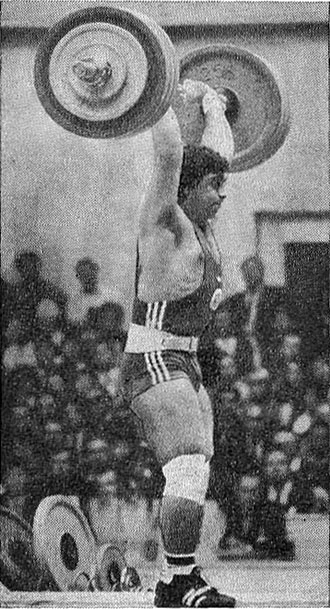
This second hard-won victory was a turning point: our chances in the team contest grew, and the performances of Mirzoyan and Sarkisyan inspired the rest, five of whom (V. Kuznetsov, V. Solodov, P. Kuznetsov, A. Popov and A. Kurlovich) were debutants.
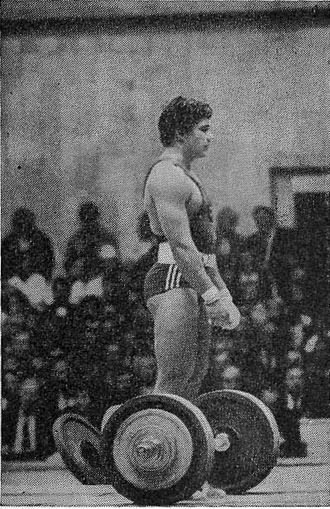
At 67.5 kg the most titled Bulgarian, Ya. Rusev, lost to Kunz of the GDR. The long-time rivals were tense in the snatch and managed only 145 kg each. In the jerk neither erred; Rusev finished on 192.5 kg, and Kunz, the heavier man, had to jerk more than that, and did.
The 75 kg contest promised interest, since Rusev, three-times champion here, had been moved down a class; Bulgaria entered world record holder A. Varbanov and the young Z. Stoichkov. V. Kuznetsov, a highly promising lifter born in 1963, snatched 162.5 kg, then a record 167.5 kg, and narrowly missed 170 kg. His jerk of 202.5 kg made a record total of 370 kg, but on his third attempt, 207.5 kg, he lost the bar at the last moment, lacking experience. Varbanov, who trailed by 7.5 kg after the snatch, jerked 210 kg, drew level on total, and as the lighter man became champion.
At 82.5 kg fans awaited Yu. Vardanyan against A. Zlatev, both Olympic champions with 400 kg, Zlatev the 1982 world champion. Vardanyan, who had knee surgery in late 1982 and no starts in 1983, did not fail his team. Both snatched 180 kg, Vardanyan with a world record of 180.5 kg, but the lighter Zlatev took the small gold medal. In the jerk Zlatev opened with 210 kg, Vardanyan went to 212.5 kg and led. Zlatev ordered 217.5 kg and missed twice, so Vardanyan became champion; his attempt at a 224 kg record failed.
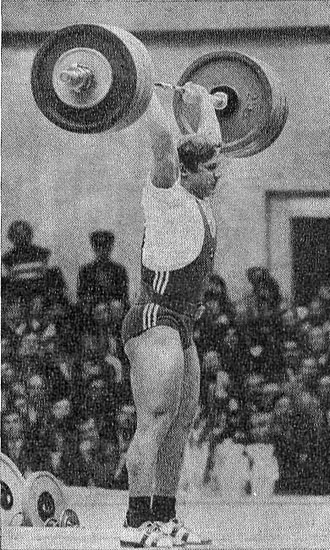
At 90 kg the Spartakiad champion V. Solodov, a young lifter with 400 kg, could hardly hope to beat two-times world champion B. Blagoev, record holder with 420 kg. His aim was to reach his maximum for targeted preparation for the Friendship-84 meet. He lost 5 kg in the snatch but made a personal best of 185 kg, and fixed 212.5 kg as his tactical jerk opener. These championships showed a richer variety of tactics than ever, evidence of high fitness and keen competition. Blagoev made 217.5, Solodov added 12.5 kg (to 225), and Blagoev then jerked 225 and 227.5 kg for 417.5 kg. Solodov went to 235 kg, 6.5 kg above the record; he cleaned it but could not jerk. Fired up, he asked for an extra fourth attempt at 230 kg and made it: a world record, and the sporting character needed to reach new limits.
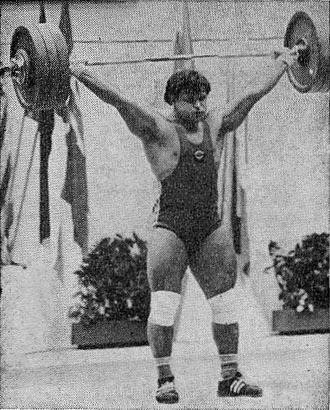
In the traditionally strong 100 kg class the USSR fielded two debutants, P. Kuznetsov and A. Popov, gold and silver medallists of the Spartakiad, since world record holder Yu. Zakharevich and last year's champion V. Sots were injured. Both did well, each totalling 422.5 kg, and the lighter P. Kuznetsov won.
The 110 kg class is prestigious for Soviet weightlifting, dominated since 1978 by Yu. Zaitsev, S. Arakelov, L. Taranenko, V. Kravchuk, Yu. Zakharevich and V. Klokov. Arakelov and Taranenko dropped out injured, leaving Klokov alone. He prepared with total commitment and made every attempt, setting four world records: two in the jerk (245 and 247.5 kg) and two in the total (437.5 and 440 kg). The silver medallist, Hungary's Ya. Iokhef, was 30 kg behind with 410 kg.
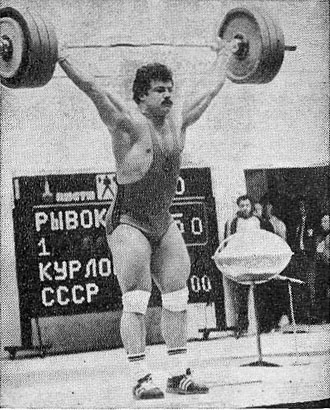
In the super-heavyweight class A. Pisarenko, two-times world champion, met A. Kurlovich, Spartakiad champion and absolute world record holder in the total; they had trained together and knew each other well, and only Bulgaria's A. Krastev could interfere. After the snatch, where Kurlovich made a maximum 205 kg and Pisarenko set a record 206 kg, it was clear the two Soviet lifters would fight it out. Both opened the jerk with 245 kg to settle the team result. Kurlovich failed his first attempt, Pisarenko succeeded; Kurlovich made his second, Pisarenko ordered 260 kg; Kurlovich passed on it and Pisarenko missed. Both then stormed the record 262.5 kg and neither held it. With equal totals of 450 kg, the lighter Pisarenko became world champion. A total record in this class is clearly ripe and our lifters are ready for it.*
Between equals one can win without world records, yet the account has one lesson: without readiness for records one cannot now think of big wins on the world platform. Weights are rising confidently elsewhere too, and the ten days at the Izmailovo Sports Palace, the Olympic venue of three years ago, should be read in that light.
* In December 1983, at the USSR Cup in Leningrad, super-heavyweight A. Gunyashev set world records in the snatch (207.5 kg) and the total (462.5 kg).