Equipment and apparatus
A Design of Electrogoniometers for Simultaneous Recording of Ankle, Knee and Hip Joint Angles
English summary of Tyazhelaya Atletika. Ezhegodnik 1984 (Moscow: Fizkultura i Sport, 1984), pp. 68–69: the text is paraphrased, not translated; figures are the original images.
Electrogoniometers are widely used to control weightlifting technique, for instance in studies of the snatch (A. A. Lukashev, 1972) and of the clean and jerk (B. A. Podlivaev, 1975).
When ankle, knee and hip angles are measured together, the three goniometers are usually strapped to the leg separately. This yields doubtful data: eight rubber straps are needed, which lengthens preparation, and the angles may not stay adjacent, as the calculations of R. A. Roman (1978) require.
The author proposes an assembly recording all three joints at once. Removable aluminium plates (7) link the goniometers and keep the angles adjacent. Since lifters differ in shank and thigh length, the plates come in several sizes, drilled along their axis at 1 cm intervals for fixing to the goniometer plates, so the instruments can be set quickly and accurately.
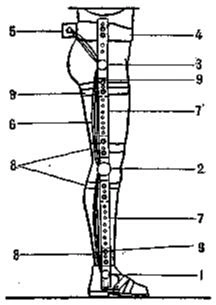
The lower fixed plate of the ankle goniometer is split, to match the height of the joint centre; the upper plate of the hip goniometer has a row of holes for precise placement on the belt. Wires lead to a connector at the back of the belt; its mating half ends a 5–6 m cable to the recorder. Round nuts 14–18 mm across secure the plates. Four rubber straps suffice to hold the goniometers on the leg. The design gives reliable data.